
This guide covers refrigerated and frozen leftover pizza reheated in a countertop toaster oven. It does NOT address full-size conventional ovens, microwave tricks, or cast-iron skillet methods.
Table of Contents
The Short Answer — For When You’re Standing in the Kitchen Right Now
Set your toaster oven to 350°F on Bake. Place your slice on the rack or tray in a single layer. Check after 5 minutes.
That’s the baseline. Done.
But the real answer is more specific — because thin crust and deep dish don’t behave the same, and a Breville with a Reheat button works differently than a Cuisinart without one. If you’ve ever pulled out a perfectly crisp-looking slice only to bite into a cold, doughy center, the problem is almost never the temperature. It’s the function setting, rack position, or crust thickness you weren’t accounting for.
According to the U.S. Department of Energy via Energy Star, toaster ovens use more than 50% less energy than conventional ovens for small-portion reheating — so you’re not only getting better pizza, you’re doing it cheaper than firing up the big oven for two slices.
What reheating in a toaster oven actually does:
The radiant heating elements above and below attack the slice simultaneously. The crust re-crisps while the cheese melts — the opposite of the microwave’s steam-everything-into-rubber approach.
Quick Definition: Reheating pizza in a toaster oven means using a compact countertop oven — set between 325°F and 375°F — to warm leftover slices until the cheese melts and the crust re-crisps. It produces better texture than a microwave by using dry radiant heat rather than steam.
The best way to reheat pizza in a toaster oven is at 325°F–350°F using the Bake or Reheat function, with slices placed in a single layer on the tray or rack. Based on testing documented at ToasterOvenLove.com (2023), starting at a lower temperature prevents toppings from drying out before the center has time to warm through. For thin crust, check at the 4-minute mark. For deep dish, allow up to 10 minutes.
Which Setting Should You Actually Use on Your Toaster Oven?
This is the section most guides skip. They tell you “set it to 350°F” without acknowledging that your oven’s function buttons produce completely different results from one another — and that a Breville behaves nothing like a Cuisinart.
To reheat pizza in a toaster oven, follow these steps:
- Remove pizza from the fridge; let it rest at room temperature for 2–3 minutes.
- Place slices on the tray or wire rack in a single layer — never stack.
- Select Reheat, Bake, or Air-Fry depending on your model (see below).
- Set temperature to 325°F–350°F; turn on convection if your oven has a fan toggle.
- Heat for 5–8 minutes total, checking at the 4-minute mark for thin crust.
- Remove with tongs when the cheese is bubbling and the crust bottom feels firm to a tap.
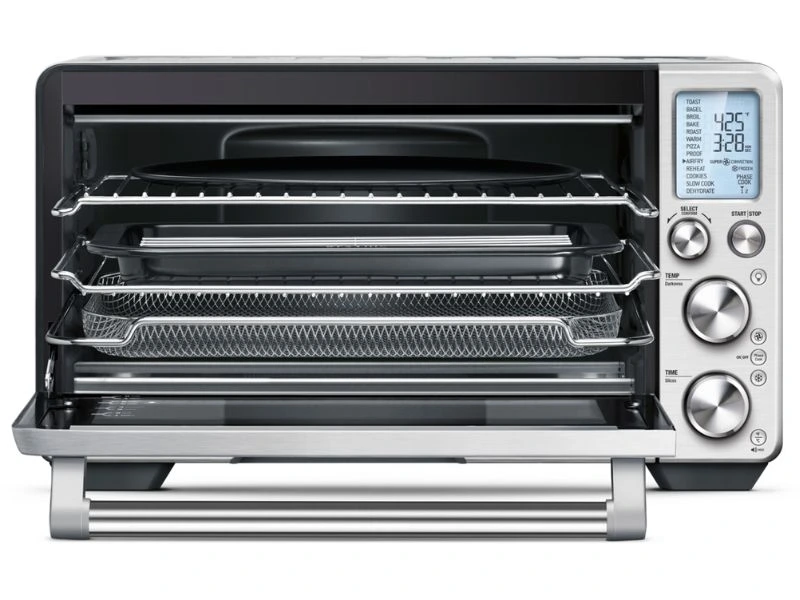
If your toaster oven has a Reheat or Leftovers button — use it, full stop. The Breville Smart Oven Air Fryer (BOV900BSS) is the clearest example: its Reheat function skips the preheat, automatically engages the convection fan, and targets gentle even warming. Users who’ve run the same slices through the Bake function on the same machine often report noticeably drier results. Stick to 325°F with this function — lower than you’d think.
If your model is Bake-only — the Cuisinart TOA-60 is probably the most common example of this — preheat for 3–5 minutes before sliding the pizza in. The preheat matters here because you don’t have a convection fan doing compensating work. Without it, the slice sits on a cold surface too long and the bottom goes limp before the top even starts to warm. Set it to 350°F.
If you have an Air-Fry toaster oven — the Ninja SP101 Foodi is practically everywhere at this point — the Air Crisp function works well, but it’s aggressive. Thin-crust pizza at 375°F on Air Crisp can turn into a cracker in under 6 minutes. Drop it to 350°F, and don’t leave the kitchen after minute 4.
Quick note: if your oven has a convection toggle, turn it on for pizza every time. The fan pulls surface moisture away from the crust as it heats — that’s the mechanical reason convection produces a crispier result without requiring higher temperature.
Exact Times and Temperatures for Every Crust Type
Thin crust vs. deep dish in a toaster oven: Thin crust heats fast and loses moisture quickly — use 350°F for 4–5 minutes and check early. Deep dish holds moisture longer and needs 350°F for 8–10 minutes to fully warm through. The key difference is crust mass: more dough means more time at the same temperature.
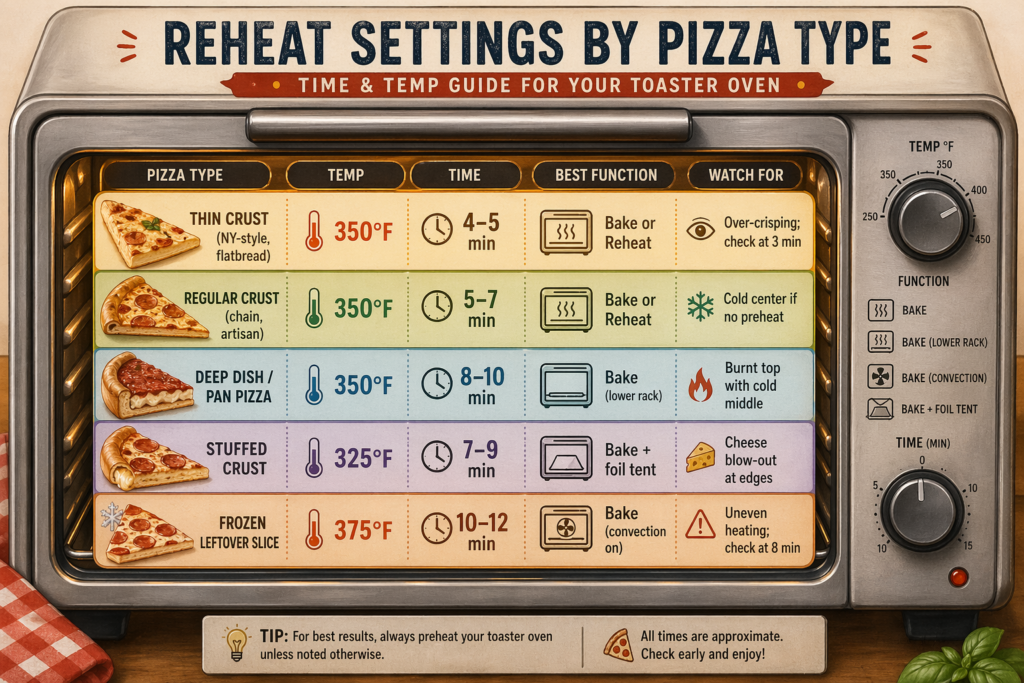
Quick Comparison — Reheat Settings by Pizza Type
| Pizza Type | Temp | Time | Best Function | Watch For |
|---|---|---|---|---|
| Thin crust (NY-style, flatbread) | 350°F | 4–5 min | Bake or Reheat | Over-crisping; check at 3 min |
| Regular crust (chain, artisan) | 350°F | 5–7 min | Bake or Reheat | Cold center if no preheat |
| Deep dish / pan pizza | 350°F | 8–10 min | Bake (lower rack) | Burnt top with cold middle |
| Stuffed crust | 325°F | 7–9 min | Bake + foil tent | Cheese blow-out at edges |
| Frozen leftover slice | 375°F | 10–12 min | Bake (convection on) | Uneven heating; check at 8 min |
How long does it take to reheat pizza in a toaster oven?
For most refrigerated slices, the answer is 5–8 minutes at 350°F. According to data compiled across multiple food testing sources including ToasterOvenLove and Mortadella Head (2023–2025), thin crust is typically done in 4–5 minutes, while deep dish may need up to 10. Total time varies by model, crust density, and whether convection is running.
What Most Guides Get Wrong — And Why It’s Costing You a Good Slice
Most people assume the hotter the better. Blast it at 400°F to speed things up. The data says otherwise.
Starting at high heat dries out the toppings and cheese before the center of the slice has time to warm through. You end up with scorched edges and a cold middle. Or maybe I should say it this way: high heat creates a race condition — the surface finishes before the interior even starts.
Here’s the thing: the entire advantage of a toaster oven over a microwave is patient, even heat. Fighting that by cranking the dial defeats the purpose.
I’ve seen conflicting recommendations across sources — some argue 325°F, others say 400°F for superior crispiness. My read is that 325°F–350°F is right for most refrigerated pizza, with 375°F–400°F reserved only for thick frozen slices that genuinely need a stronger initial burst to break through the ice-crystal layer in the dough.
What most guides also skip: rack position. Middle rack is correct for regular and thin crust. For deep dish, the lower rack is better — it keeps the toppings farther from the top heating element, so the cheese doesn’t scorch before the thick dough base warms through.
Some experts argue you should skip preheating entirely — particularly when using a dedicated Reheat function — because placing cold pizza in a gradually warming oven prevents the surface from outpacing the interior. That argument holds for refrigerated pizza. For frozen pizza, always preheat. The ice crystals in the dough need a consistent initial heat to release cleanly rather than pooling as surface moisture.
Why does pizza get soggy in the microwave but crispy in a toaster oven? Microwaves excite water molecules inside the food, which generates steam — that steam softens the crust from the inside out. A toaster oven uses dry radiant heat from above and below, which evaporates surface moisture and re-crisps the crust instead. According to food science sources, a convection fan accelerates this effect by actively removing moisture-laden air from around the food as it releases.
Frozen Leftover Pizza in a Toaster Oven — The Case Nobody Covers
This gets its own section. Frozen pizza and refrigerated pizza are not the same problem, and treating them identically is why you end up with a slice that’s steaming on the outside and icy in the middle.
Refrigerated pizza is simply cold. It’s structurally intact — just needs gentle warming. Frozen leftover pizza has ice crystals that formed inside the dough and cheese during freezing. Those crystals release water as they melt. That water is exactly what creates sogginess if the heat isn’t high enough or fast enough to evaporate it as it emerges.
For frozen leftover slices — here’s what actually works:
- Preheat to 375°F (higher than you’d use for refrigerated)
- Use Bake with convection on — not the Reheat function
- Place the slice on a wire rack, not flat on a tray; this lets released moisture escape from underneath
- Allow 10–12 minutes total; check at the 8-minute mark
- Thin frozen crust exception: drop to 350°F and check at 6 minutes
But if you don’t have that time, you don’t have patience for thawing overnight, and you’re not aiming for perfection — the 375°F Bake method above handles it directly from frozen.
Five Questions People Actually Ask Out Loud
Q: What’s the best temperature to reheat pizza in a toaster oven?
350°F is the most reliable starting point for refrigerated pizza. Use 325°F with convection for the gentlest reheat, or bump to 375°F for frozen slices. Adjust based on crust thickness and your specific model.
Q: How do I reheat pizza in a toaster oven without it getting soggy?
Use Bake or Reheat — not the microwave. Place the slice on a wire rack rather than flat foil. Keep temperature at 325°F–350°F with convection on to pull moisture away from the crust surface as it heats.
Q: Should I preheat my toaster oven before reheating pizza?
It depends on the model. If your oven has a Reheat button — like the Breville BOV900BSS — skip the preheat; it’s designed for that. For Bake-only models like the Cuisinart TOA-60, preheat 3–5 minutes so the pizza doesn’t sit on a cold surface.
Q: Why does my pizza crust get hard and dry in the toaster oven?
Temperature is too high or time is too long. Drop to 325°F and check 1–2 minutes earlier than usual. A very light mist of water on the top of the slice before reheating can also help the cheese melt without the crust over-drying.
Q: When should I use the Air-Fry setting to reheat pizza?
Use Air Crisp or Air Fry only if you want an aggressively crispy result. Set it to 350°F — not the machine’s default 400°F — and check at or before 5 minutes. Thin crust especially will go from perfect to cracker-like in under a minute once it crosses the threshold.
Look — if you’ve tried 350°F and your slices keep coming out with a cold center, the problem is almost never your technique. Toaster ovens vary more than any other small appliance in actual vs. displayed temperature. Bump to 375°F, add 2 minutes, and check again. That’s the fix.
Explore our other pizza-related categories for mouthwatering articles and tips. Check them out now!
Learn How To Clean A Pizza Oven Like A Pro!
5 Types Of Pizza Ovens: Which One Will You Choose?
Ultimate Guide: How To Use Blackstone Pizza Oven?